
Dental Implants
A stable foundation designed to help restore the comfort, appearance, and function of missing teeth.
Implant Dentistry
Dental implants can replace one tooth, several teeth, or support a complete arch of replacement teeth. Treatment involves surgically placing a small implant post—commonly made of titanium or another biocompatible material—into the jawbone.
Understanding the parts
A dental implant is not the visible replacement tooth. A completed single-tooth restoration generally includes:
- The implant post, which is placed in the jawbone
- The abutment, which connects the implant to the restoration
- The dental crown, which is the visible replacement tooth
Implants may also support bridges or fixed or removable implant-supported dentures.
Options for replacing teeth
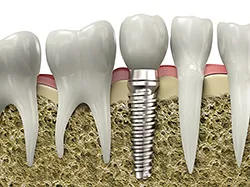
- A single implant and crown can replace one missing tooth
- Several implants may support a bridge when multiple teeth are missing
- Multiple implants may support a fixed or removable full-arch restoration
The number and position of implants depend on your oral health, available bone, bite, and the type of restoration being planned.
What treatment involves
Treatment begins with an examination, medical and dental history, and appropriate imaging. If gum disease, decay, or another active condition is present, it may need to be treated first. Some patients may require bone grafting or referral to a specialist.
After the implant is placed, the surrounding bone must heal and integrate with it through a process called osseointegration. Healing may take several months, although treatment timelines vary. Once the implant is sufficiently stable, the abutment and custom restoration can be placed.
Are you a candidate?
Candidacy depends more on your health than your age. Your dentist will evaluate:
- The condition of your gums and jawbone
- Your general health and ability to heal
- Medications and relevant medical conditions
- History of gum disease
- Tobacco use
- Grinding, clenching, and oral-hygiene habits
Smoking and conditions such as uncontrolled diabetes may increase complications or interfere with healing, but they do not automatically disqualify every patient.
Benefits and limitations
Implants can provide stability and may replace teeth without requiring neighboring teeth to support the restoration. However, implant treatment involves surgery and is not appropriate for every patient.
Possible complications include infection, delayed healing, implant failure, damage to nearby structures, and inflammation or bone loss around the implant. Your dentist will discuss your individual risks, alternatives, expected timeline, and costs before treatment.
Caring for your implants
Implants cannot develop cavities, but the gums and bone around them can develop inflammatory conditions known as peri-implant diseases. To support their long-term health:
- Brush twice daily
- Clean carefully around and beneath the implant restoration
- Use floss, interdental brushes, or another tool recommended by your dentist
- Attend professional maintenance appointments at the interval recommended for you
- Avoid tobacco use
- Report bleeding, swelling, discomfort, or looseness promptly
Implant posts and their crowns, bridges, or dentures may have different service lives. Repairs, component replacement, or additional treatment may eventually be necessary.
Monitoring your implants
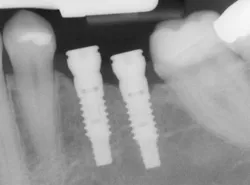
Dental X-rays may be used during follow-up appointments to evaluate the implant position, supporting bone, and surrounding structures.
Explore More
Related services
Ready when you are
Request your appointment online and we'll follow up quickly to find a time that fits your schedule — new patients are always welcome.